
Sub-Total: $0.00

August 18, 2026
How to Choose the Right Golf Simulator: A 2026 Buying Guide
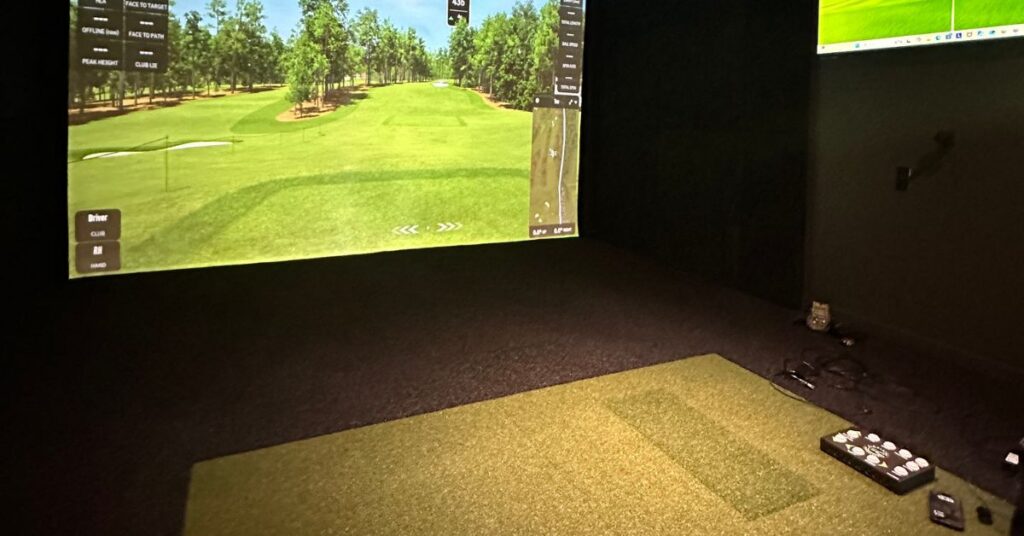
Most people shop for a golf simulator backwards. They pick a launch monitor from a review video, then find out their basement ceiling is 8 feet, the unit needs to sit where the couch is, or the software they wanted costs another $450 a year to unlock.
Work the other direction and the decision gets much simpler. Your room narrows the field first, how you plan to use the simulator narrows it again, and by the time you get to hardware there are usually only two or three sensible answers. Here is that order, with 2026 pricing on the equipment we sell and install.
If you want the dollar figures first, our golf simulator cost breakdown covers what each tier totals.
Step 1: Measure Your Room Before You Shop
Space eliminates more simulator plans than budget does. Three dimensions matter, and ceiling height matters most.
Ceiling height. A full driver swing needs about 9 feet of clearance, and a mat adds another inch or two. Ten feet is comfortable for most golfers. Taller players with steep swings want 10.5 feet or more. Below 9 feet, you are looking at shorter clubs, a modified swing, or a different room.
Width. Ten feet is the working minimum. Twelve gives a right-handed and a left-handed player room to share the space without moving anything.
Depth. Twelve to 15 feet is typical. Radar units need considerably more, which is the single biggest space trap in this category.
Overhead units have their own ceiling math because the sensor mounts above you:
| Unit | Ceiling Height Needed | Mounting Position |
| Uneekor EYE XR | 9 to 10 feet | Overhead, about 3.5 to 4 feet behind the ball |
| Uneekor EYE XO | 9 to 10 feet | Overhead, about 3.5 feet in front of the ball |
| Uneekor EYE XO2 | 10.5 feet minimum | Overhead, in front of the ball |
| Foresight Falcon | 9.5 to 10.5 feet | Overhead, 4 feet in front of the hitting area |
| TrackMan iO | Standard ceiling | Overhead, minimal footprint |
Radar is the outlier. TrackMan 4 needs roughly 16 feet from the unit to the screen indoors because it tracks the ball in flight rather than reading it at impact. In a 12-foot basement, that unit is not an option no matter what your budget says.
Camera-based units read the ball in the first few inches after impact, so they work in far tighter rooms. That is why nearly every home build we do uses photometric tracking.
Step 2: Decide How You Will Use It
What will you be doing in this room 90% of the time?
Entertainment and family use. You want course play, forgiving setup, and something guests can figure out. Data precision matters less than reliability. The Uneekor EYE MINI LITE at $2,749 or the Bushnell Launch Pro at $2,999.99 both do this well. If you want the room to do more than golf, TruGolf Multisport at $4,500 adds a camera-based system with 14 games covering baseball, hockey, soccer, football, and more. It works alongside whatever golf tracking you already have.
Practice and improvement. You want dependable club data, because you cannot fix a path problem you cannot see. This is where the Uneekor EYE XR and Foresight GC3, both $6,999, earn their price. Add Uneekor Swing Optix cameras at $1,700 if you plan to work with an instructor.
Fitting, coaching, and teaching. Numbers have to hold up when a student or a customer questions them. The Foresight GC Quad at $15,999.99 and GC Quad MAX at $19,999 measure loft, lie, and impact location on the face, which the cheaper units estimate. TrackMan 4 at $25,995 is the choice when you need the same unit to work outdoors on a range tee.
Commercial and revenue-generating. Durability, throughput, and licensing change the math. Skip to the commercial section below.
Be realistic here. A golfer who plays twice a month and wants to play Pebble Beach with friends does not need a $20,000 tracking unit. A single-digit handicap chasing a swing change will outgrow a $2,749 unit inside a season.
Step 3: Understand the Three Tracking Technologies
Every launch monitor falls into one of three camps, and the camp determines the room you need more than the brand does.
Radar tracks the ball through its flight using Doppler. It measures carry and ball flight directly, works outdoors, and needs distance to do its job. TrackMan 4 is the reference point. The tradeoff is space: radar wants 16 feet or more indoors.
Photometric, also called camera-based, photographs the ball and club at impact with high-speed cameras, then computes the flight. It needs almost no depth, works in tight rooms, and reads club data well. Uneekor and Foresight both use this approach. Uneekor’s Dimple Optix reads the dimple pattern on a standard ball, so no marked balls are needed on current models. Foresight units work with any ball too.
Hybrid radar and camera systems combine both. TrackMan calls its version Optically Enhanced Radar Tracking. TrackMan iO pairs 24 GHz radar with dual high-speed cameras at up to 4,600 frames per second, measures 3D spin directly, and needs no markers on the ball or club. It is indoor-only by design, which is why it costs $23,995 while TrackMan 4 costs $25,995 and adds outdoor use.
One detail people miss: some units measure a metric and others calculate it. A calculated spin number derived from ball speed and launch angle is a good estimate. A measured spin number is data. That gap is invisible on a spec sheet and obvious the first time you get fitted with a different device.
Club stickers are a related annoyance. The Uneekor EYE XO uses reflective club stickers for full club data. The EYE XR uses Club AI instead, so no stickers. If reapplying small stickers to your irons sounds tedious, that alone can decide the model.
Step 4: Floor-Mounted or Overhead
This is the second structural decision, and it is harder to reverse than any other.
Floor-mounted units sit beside the ball. They are portable, cheaper to install, and can move between rooms or go outdoors. The catch is handedness: a left-handed player and a right-handed player cannot share the bay without physically moving the unit. If your household is mixed, you will move that box several times per session, and eventually you will stop inviting people over.
Overhead units mount to the ceiling and stay there. Floor space stays clear, both handedness work without touching anything, and the hitting zone is usually larger. The Foresight Falcon has a 59 by 28 inch hitting zone, which is why it shows up in facilities where strangers walk up and hit. The tradeoffs are permanence, a ceiling that can carry the mount, and running power overhead.
| Floor-Mounted | Overhead | |
| Examples | EYE MINI LITE, EYE MINI, Bushnell Launch Pro, GC3, GC Quad | EYE XR, EYE XO, EYE XO2, Foresight Falcon, TrackMan iO |
| Mixed handedness | Move the unit each time | No adjustment |
| Portability | Packs up, some work outdoors | Permanent |
| Floor space | Occupied beside the hitting area | Clear |
| Install cost | Lower | Higher, includes mounting and wiring |
If the room is dedicated to golf and more than one person will use it, overhead is almost always the right answer. If the space does double duty as a garage, a spare room, or a place you park a car in winter, floor-mounted keeps you flexible.
Step 5: Pick the Software Before You Pick the Hardware
This is the step buyers skip, and it produces the most regret. Software determines what the room feels like to use, and several platforms carry fees that are not part of the hardware price.
GSPro is the most popular choice for serious home players. It licenses at $250 per year and has an enormous community-built course library.
E6 Connect costs from $300 per year for the base library and $600 for the expanded one, with licensed courses and strong graphics.
TGC 2019 is a one-time purchase around $949 with a large course library.
Manufacturer platforms come with the hardware. Uneekor has its own simulation environment, Foresight has FSX PLAY, and TrackMan has Performance Studio.
Here is the part that catches people. Reaching third-party software often takes a manufacturer subscription first:
| Platform | Free Tier | Paid Tier to Unlock Third-Party Software |
| Uneekor | Player: ball and club data, virtual range | Pro, $199/year, opens GSPro, E6 Connect, TGC 2019 |
| Bushnell Launch Pro | Ball data and the Foresight app | Silver $199/year adds full club data and FSX PLAY; Gold $499/year opens GSPro |
| TrackMan | Included with hardware | Annual subscription around $2,500 |
So a Uneekor unit paired with GSPro costs $199 plus $250, or $449 a year. A Bushnell Launch Pro on GSPro costs $499 plus $250, or $749 a year. Neither figure appears on a product page. Over five years that difference is $1,500, which is more than the gap between two hardware models people agonize over.
Before you buy, confirm three things: which platforms the unit connects to, which manufacturer tier that connection needs, and whether the club data you want is behind that tier.
Step 6: Match the Projector and PC to the Tracking Unit
Two supporting pieces get chosen carelessly and then cause problems.
The projector has to be short throw. A standard projector mounted 15 feet back puts your shadow on the screen on every swing. The BenQ TK700STi at $1,799 handles most first builds. The BenQ AH700ST at $2,299 adds keystone and corner-fit adjustment made for simulator mounting. Commercial bays use the LK936ST laser at $4,899 for brightness and lamp life.
The computer has to match the software. Simulator software leans hard on the graphics card, and a machine that stutters ruins a round. Our SC Gen1 1080 PC is $3,449.36 and the SC Gen2 4K PC is $4,202.37, both configured for the platform you choose: GSPro, TrackMan, Foresight, ProTee, or TruGolf and E6. If you project in 4K, buy the 4K machine. A 1080p PC driving a 4K projector produces exactly the stutter you were trying to avoid.
Choosing for a Commercial Space
Three things change when the simulator earns money in a commercial space.
Licensing. Most software costs more for commercial use, and using a residential license in a paid venue violates the terms. Sort this out before you buy hardware, not after.
Throughput. Customers of every handedness and skill level walk up and swing. A large hitting zone and an overhead unit that needs no adjustment between players saves staff time every hour you are open. This is where the Foresight Falcon and the ceiling-mounted Uneekor units pull ahead of anything floor-mounted.
Durability and support. A unit that gets 40 hours a week of use needs a support path that does not involve a forum thread. Ask what the warranty covers, what the response time is, and who does on-site service.
Bay economics: most markets support $40 to $70 per bay-hour. Hardware costs $19,000 to $75,000 per bay and build-out adds $40,000 to $75,000 for walls, electrical, HVAC, and flooring. A four-bay venue typically totals $350,000 to $600,000.
Questions to Ask Any Simulator Company
- What are my room’s limiting dimensions, and which units does that rule out?
- Is the club data I care about measured or calculated on this unit?
- What are the total annual software costs to reach the setup you are quoting?
- Does this unit work for left-handed and right-handed players without adjustment?
- What does installation include, and what am I responsible for before you arrive?
- Who do I call when something stops working, and what is the response time?
A company that answers the first question with a product recommendation before asking your ceiling height is selling inventory, not designing a room.
Frequently Asked Questions
What is the most important part of a golf simulator?
The launch monitor, because it sets the ceiling on everything else. A $700 tracking unit in a $20,000 room produces data you will stop trusting. The room comes second, since a space you cannot swing in cannot be fixed with hardware.
Do I need a special golf ball?
Not with current Uneekor or Foresight units. Uneekor’s Dimple Optix reads a standard ball, and Foresight units work with any ball. Some older models and some competing systems still want marked balls, so confirm before buying.
Can left-handed and right-handed golfers share a simulator?
With an overhead unit, yes, with no adjustment. With a floor-mounted unit, the sensor has to be physically moved between players. For a mixed household or any commercial space, overhead is the practical answer.
Which golf simulator software is best?
GSPro at $250 per year is the most popular for serious players and has the largest course library. E6 Connect from $300 per year has better licensed courses and graphics. Check which one your launch monitor connects to, and what manufacturer tier that connection needs.
Do I need a dedicated room?
No, but a dedicated room is easier. Retractable screens and portable floor-mounted units let a garage or a family room convert. Expect setup and teardown time on every session.
How long does installation take?
A straightforward residential install is typically one to two days once the room is ready. Rooms needing framing, electrical, or ceiling work take longer, and that work happens before the equipment arrives.
Let Us Look at Your Room First
The right simulator is the one that fits your ceiling, your budget, and the way you will use the space. That combination is different in every house, which is why we start with dimensions and a conversation rather than a product list.
We design and install golf simulators throughout Michigan, Ohio, Indiana, Illinois, and Wisconsin, and we provide mobile rentals for events. Send us your room measurements and tell us how you plan to use it.
Request a free quote, browse the full equipment catalog, or see past installations in our project gallery.
Posted in Custom Installation
Let's Get Started
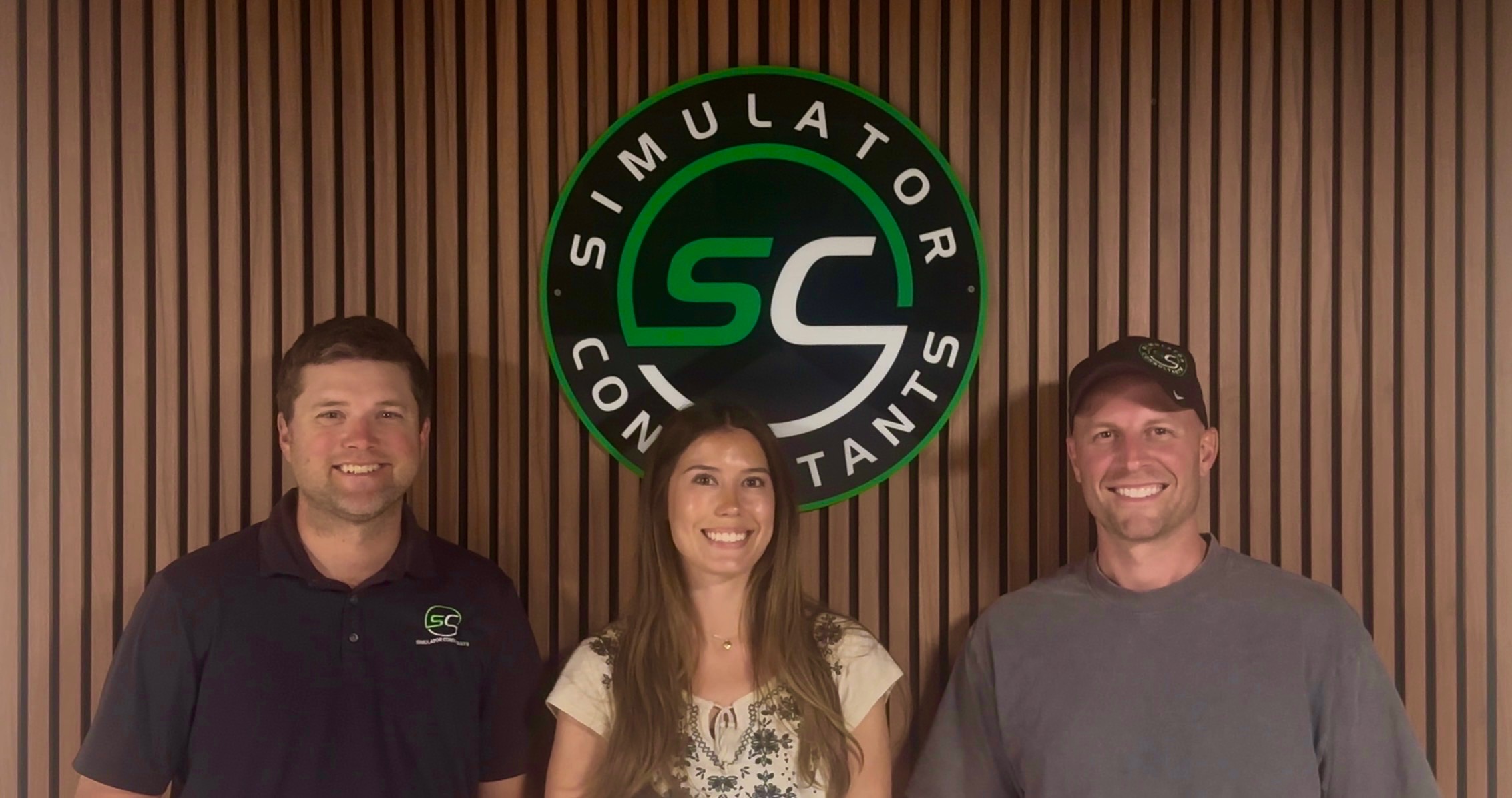
Meet Our team
From your first call to the final install, you'll be working directly with the team building your space and sourcing your equipment.
Request Custom Installation
“*” indicates a required field.